

Color bleeding. It’s the moment of dread when your favorite white item suddenly has an unwanted pink or blue tint. This dye-transfer catastrophe can ruin your expensive silks, cherished vintage items, and everyday wardrobe staples.
While home cleaning tips are basic, garments labeled “Dry Clean Only” demand specialized care. For top-notch fabric safety, you need a reputable dry cleaning service in Dallas. We don’t just clean clothes; we preserve their color integrity. Our dallas dry cleaning experts understand the unique challenges of modern and vintage textiles. This guide shows you the technical steps we take to make sure color bleeding is never an issue.
The Science of Dye Transfer: Why Colors Bleed
Color bleeding happens when the dyes used to color a fabric are not securely attached to the fibers. They loosen and migrate. A professional dry cleaning service in Dallas must manage two main causes:
1. Solvent-Soluble Dyes (The Dry Cleaning Risk)
Dry cleaning uses a solvent instead of water. Some dyes, called fugitive dyes, easily release from the fabric when exposed to certain dry cleaning solvents.
Common Culprits: Deep, intense colors like blacks, reds, and navies are often the issue.
The Danger: When this dye loosens, it contaminates the cleaning solvent. This can lead to a color transfer onto lighter garments in the same batch.
2. Water-Soluble Dyes and Moisture (The Hidden Risk)
Even though it’s called dry cleaning, trace amounts of moisture are often involved. Many dyes are perfectly stable in the solvent but will bleed instantly if they encounter even a small amount of water or steam.
High-Risk Items: This is a common problem with two-tone garments.
Our Solution: A professional dallas dry cleaning technician must meticulously control the moisture levels inside the cleaning machine. This is a primary defense against this type of bleeding.
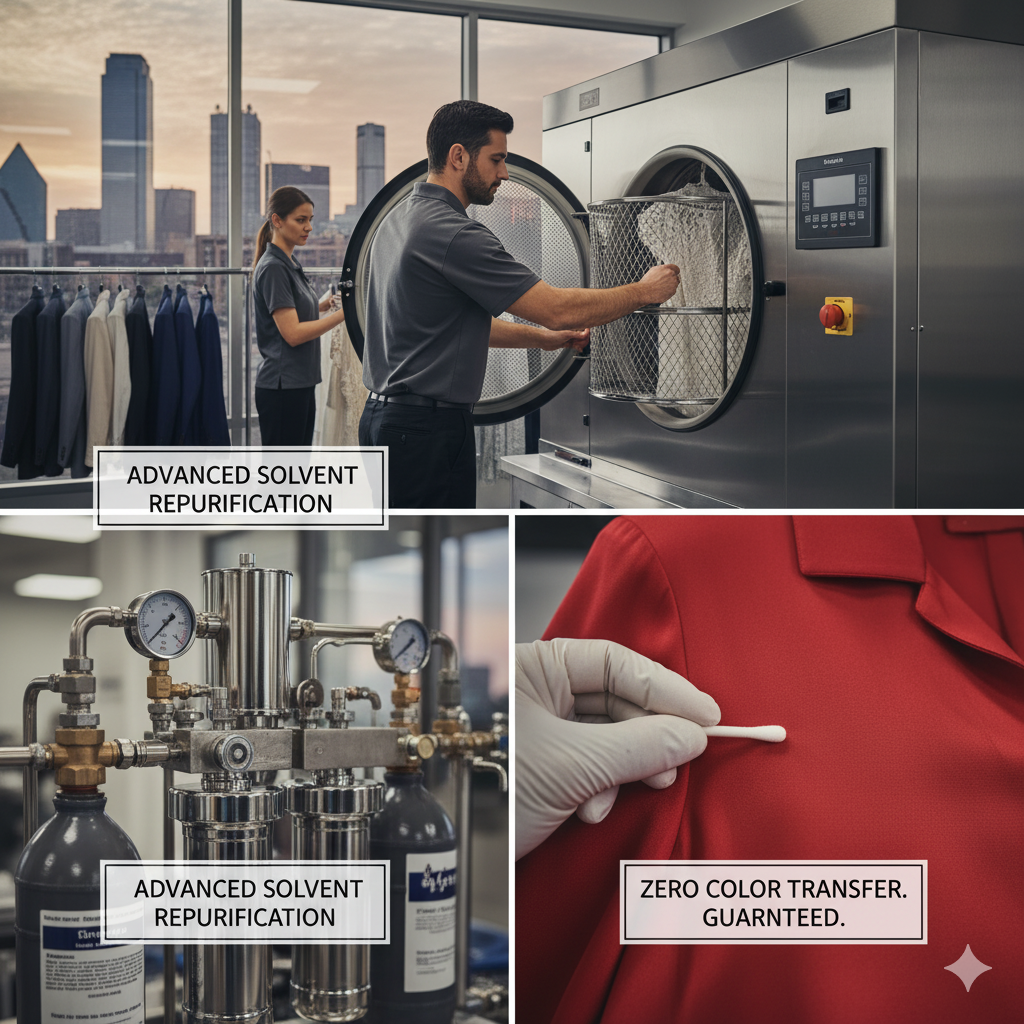
Foundational Pillar: Professional Pre-Cleaning Inspection
The most important step for preventing color bleeding happens before your garment ever touches the cleaning machine. This is the thorough inspection and pre-testing process.
The Vital Colorfastness Test
Every questionable garment—especially new items, dark colors, or those with contrasting trims—undergoes a colorfastness test. This is an essential diagnostic step that home launderers simply cannot replicate.
The test procedure is meticulous:
Locate Test Area: The technician finds a small, hidden spot (like an interior seam or hem allowance).
Dampen Swab: A cotton swab or small white cloth is dampened with the exact dry cleaning solvent to be used.
Apply Pressure: The damp swab is firmly pressed against the test area for a set time.
Analyze Result: If color transfers to the white cloth, the garment is flagged as a “bleeder.”
If the item is a bleeder, it requires special, isolated processing. This simple test by your dry cleaning service in Dallas saves your garment from potential ruin.
Care Label Analysis and Garment Log
The care label is our first clue. An experienced dallas dry cleaning professional always reviews the cleaning instructions, noting warnings like “colors may run.”
Documentation: This information is logged alongside the colorfastness test result.
Strategy: If the label says “Dry Clean Only” and the colorfastness test fails, the item is automatically scheduled for isolation. This ensures every piece gets a customized cleaning strategy.
Separation and Isolation
Items that fail the colorfastness test are immediately flagged for isolation. High-risk garments are processed in one of two ways:
Individual Net Bags: They are placed in fine-mesh bags. This allows the cleaning solvent to circulate but physically separates the item from all others, eliminating contact and transfer.
Dedicated Small Batches: They may be cleaned in a small, separate load only with other known bleeders of similar color (e.g., all deep blue items together).
Advanced Dry Cleaning Methods for Color Protection
The technology inside a professional dry cleaning machine provides crucial control and precision. This is why a professional dry cleaning service in Dallas is the superior choice for color safety.
Meticulous Solvent Management
The quality of the cleaning solvent is critical. Dry cleaning solvent is recycled, so if it’s dirty, it will cause color bleeding on the next load.
| Process Step | Purpose | Benefit |
| Continuous Filtration | Runs solvent through a filter to remove soil and particles. | Basic level of cleanliness. |
| Solvent Distillation | Solvent is boiled into a vapor, leaving all contaminants (including loose dyes) behind. | Produces “virgin” pure solvent, eliminating loose dyes that cause bleeding. |
| Moisture Control | Machine settings are tuned to keep moisture extremely low. | Prevents water-soluble dyes from bleeding. |
Cleaning in distilled, clean solvent is the gold standard for preventing dye transfer.
The Role of Dye-Setting Chemicals
For garments that are borderline colorfast, we use specialized chemical agents to stabilize the dye.
Cationic Dye Fixatives: These chemicals are applied as a pre-treatment. They chemically bond with the dye molecules, making the color more secure and resistant to both solvent and moisture. They are often used for silks and brightly colored cottons.
Sizing Agents and Finishes: Applying a professional sizing agent helps restore the garment’s texture. It also encapsulates the dye, acting as a protective barrier that minimizes dye movement.
Controlled Drying and Pressing
The final stages are also carefully controlled to avoid setting any transferred color.
Low-Temperature Drying: Excessive heat sets stains and transferred dyes permanently. Garments are dried at the lowest effective temperature possible.
Precise Steam Control: In the finishing stage, pressing and steaming must be precise. Too much steam on a color-sensitive area can cause localized bleeding right on the press. Experienced dallas dry cleaning technicians are trained to watch for and prevent this.
Home Care Tips: What You Can Do
While your dry-clean-only items are safest with a professional dry cleaning service in Dallas, here are tips for your regular laundry:
Always Sort Meticulously: Never mix whites, lights, and darks. Sort by fabric type, too, as different materials release dye at varying rates.
Use Cold Water: Cold water is far less likely to loosen dye bonds than warm or hot water. Use cold settings whenever possible for maximum color protection.
Do NOT Treat Stains on Dry-Clean-Only Items: If you spill something, do NOT try to treat the stain with water, salt, or vinegar. Any liquid can cause instant, permanent color bleeding or ring marks.
Immediate Action: Blot the area gently and take the garment immediately to your local dallas dry cleaning expert, making sure to point out the stain location.
Why Choose a Local Dallas Dry Cleaner for Color Safety?
Choosing an established, local dry cleaning service in Dallas means you’re investing in textile expertise, not just a wash cycle.
Our team is specially trained to identify complex fabric and dye sensitivities—a level of detail a large, automated plant often cannot match. We use modern, professional equipment for continuous solvent purification and gentle, effective cleaning.
Our commitment to the community means we offer personalized service and attention to every garment. By choosing a local dallas dry cleaning expert, you ensure that the advanced, multi-step processes of pre-testing, solvent distillation, and professional finishing are executed with the highest standard of care, preserving your clothes’ original, vibrant look.

Frequently Asked Questions (FAQ) on Color Bleeding Prevention
Can dry cleaning actually cause color bleeding?
Yes, but only if the dry cleaner fails to follow professional standards. Bleeding occurs when a garment with solvent-soluble dyes is cleaned in unpurified solvent, or if a water-soluble dye is exposed to excess moisture. A high-quality dry cleaning service in Dallas uses distillation and pre-testing to virtually eliminate this risk.
Which colors are most likely to bleed, and why?
Reds, blacks, deep blues (like navy), and vibrant jewel tones are the most common bleeders. These colors require a higher concentration of dye, and the chemical structure of those specific dyes often makes them less securely fixed to natural fabrics like cotton, silk, and wool.
Does a “color catcher sheet” work in dry cleaning?
No. Color catcher sheets trap dye in water during home washing. They are not chemically designed to work in a professional dry cleaning solvent. Professional cleaning relies on far more effective methods like distillation and specialized fixative chemicals.
Can you fix color bleeding that has already happened?
Sometimes. If color bled during a home wash, bring the garment immediately while it is still wet. Do not use the dryer, as heat will set the dye permanently. If the bleed occurred during professional dry cleaning, the cleaner may attempt a highly specialized color-stripping procedure to lift the transferred color without damaging the base color.
Q: What is the difference between “bleeding” and “crocking”?
Bleeding is when the dye loosens and travels through the liquid (water or solvent) to stain another area. Crocking is the transfer of dry dye by friction. This is why a new pair of dark jeans might rub off color onto your hands or a white couch. Crocking is surface dye that usually stops after the first few cleanings.
Is it safe to dry clean an item with contrasting colors (e.g., black and white)?
Yes, but it requires extreme care. A professional dry cleaning service in Dallas will always perform a colorfastness test on both colors. If any instability is found, the garment is treated with dye fixatives and processed in a tightly controlled, isolated environment to prevent the dark dye from migrating to the white.
Preserving the colors and lifespan of your garments requires the skill and technology of a true professional. If you are looking for a trusted dry cleaning service in Dallas that prioritizes color safety above all else, contact us today to experience the difference expert care makes.
